Posted on: 29th January 2026
Led by the Northern and Yorke Landscape Board, the monitoring data shows exceptionally high reproductive success, with 98% of females captured carrying pouch young, and the remaining females showing evidence of recent breeding.
Returning yalgiri is part of Marna Banggara, an ambitious project to restore lost native wildlife to southern Yorke Peninsula. They were locally-extinct for more than 100 years prior to their reintroduction due to habitat loss and the spread of introduced predators, namely foxes and feral cats.
A brush-tailed bettong, known as yalgiri to the local Narungga people. Photo courtesy of Northern and Yorke Landscape Board.
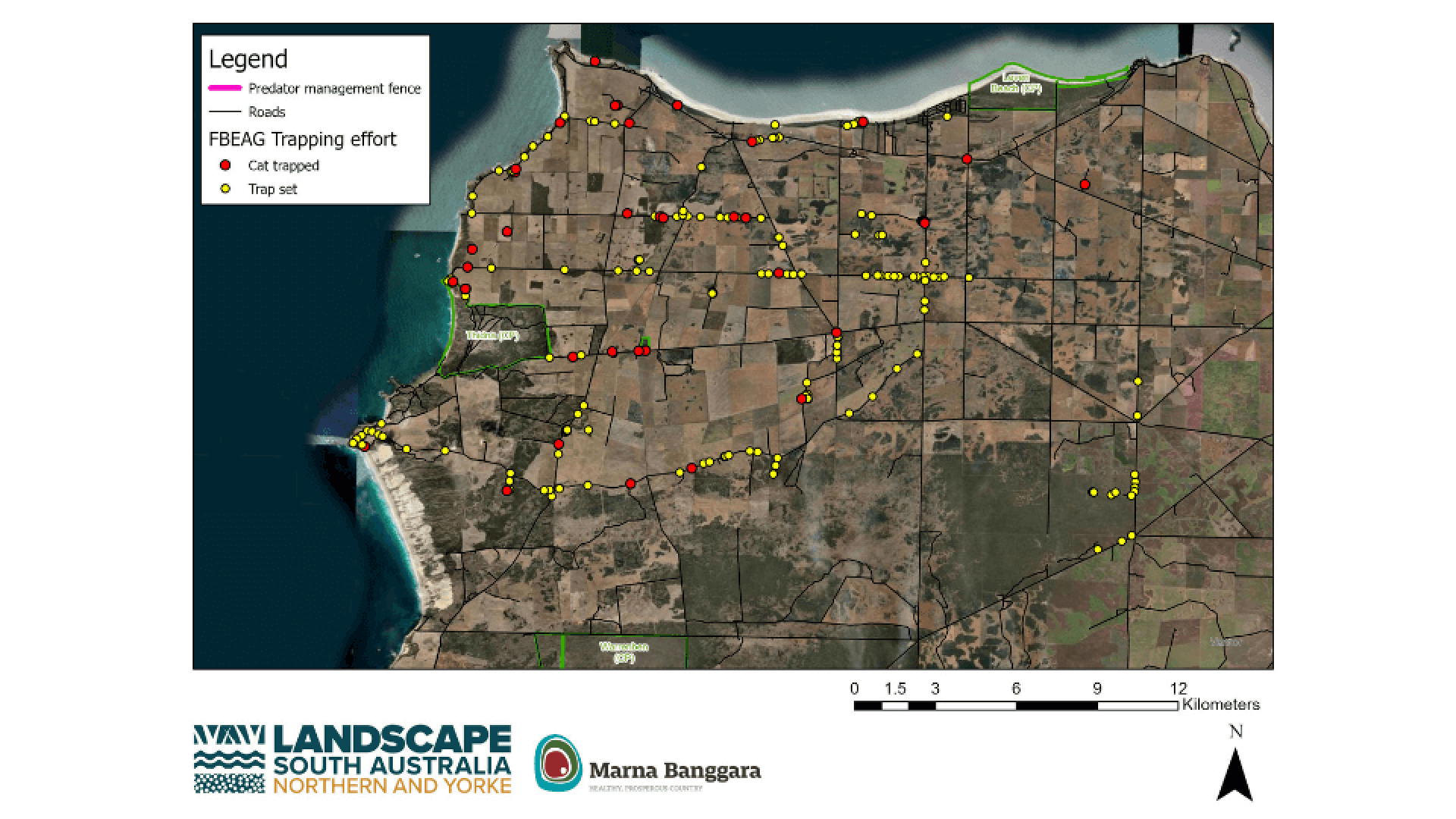
Murray Williams cat trapping map. Image courtesy of Northern and Yorke Landscape Board.
Northern and Yorke Landscape Board Project Manager Derek Sandow said the total yalgi population was now estimated to be more than 500, with most yalgiri now locally born.
“While it’s still early days . . . only 4 years in, it is a powerful sign to see potentially 10 generations of animals on Country. Monitoring has occurred across multiple seasons with results indicating that they are successfully breeding up to 2-3 times per year,” he said.
“Much of this success has been the result of the hard-working Marna Banggara predator control team, in reducing feral cat and fox numbers to enable the species to have a fighting chance of survival.”
Over the past year, in partnership with local landholders and the National Parks and Wildlife Service, the team has undertaken more than 25,000 hectares of targeted fox and feral cat control and 15,000 nights of camera monitoring for predators.
Locals Murray Williams and Stuart Murdoch, along with the Formby Bay Environmental Action Group (FBEAG), have also been a pivotal part of this program helping to reduce the number of feral cats in the southern Yorke region.
Murray and members of FBEAG used traps supplied by the Marna Banggara team to capture 98 feral cats since late last year.
“It’s amazing the amount of damage cats can cause,” said Stuart Murdoch.
“Even in terms of meat production, cats carry diseases, like cysts, which can be transferred to our livestock.
“On the last load of lambs we sent to market, we had two condemned because of this issue.”
Murray Williams urged southern Yorke landholders to get involved in the project not only to help the environment, but the benefits it provides the community and farmers by keeping predator numbers down.
“Female cats only need to be four months old to breed,” said Murray.
“Even with the 60 I caught myself, assuming half were female, that could mean an extra 400 cats over the next few years.”
Predator control workshops run by FBEAG will be available early next year to encourage community involvement.
Locals interested in supporting the project, including borrowing feral cat and fox cage traps (with conditions), are encouraged to contact the Northern and Yorke Landscape Board by calling 8841 3444.
Locals are also encouraged to report feral cat and fox sightings using the Feral Scan app.
Marna Banggara is jointly funded by the Australian Government Natural Heritage Trust and the Northern and Yorke Landscape Board, a member of the Commonwealth Regional Delivery Partners panel.
For more information, visit www.marnabanggara.com.au